Negotiating with extremist groups in the Horn of Africa has proved arduous and frequently futile. Trust between the parties involved remains a persistent obstacle, resulting in communication breakdowns and an incapacity to find a middle ground.
The divergent objectives and stipulations of these groups further complicate the search for commonality, often clashing with those of the government or other negotiators. Moreover, external influences such as international pressure or meddling by foreign entities compound the intricacy of these negotiations.
We explore why negotiations with extremist, armed groups is a long shot for peace, and stability in Somalia, look at whether there is appetite within al-Shabaab leadership to negotiate, and whether there can be an interest on the part of al-Shabaab leadership to disengage and pursue political dialogue with the Somali government.
By Ali Ibrahim
Extremist and armed groups form a complex fabric in global security, geopolitics and the war on terrorism.
These groups, driven by ideologies that often challenge established norms and systems, vary widely in their objectives, methods, and impact. Ranging from religious and political extremists to separatist movements and insurgent forces, they utilize ideological fervour and military power to pursue their agendas.
The extremist groups, often grounded in ideologies that are radical departures from mainstream beliefs, can span a spectrum of motives. Whether driven by religious fundamentalism, ethnonationalism, or ideological fervour, they seek to reshape societies and power dynamics through unconventional means through propaganda, radicalization, and violent tactics.
They exploit vulnerabilities, grievances, socioeconomic disparities, and political disillusionment to garner support, with regional and global implications that reshape geopolitical landscapes and pose challenges to established security paradigms.
Negotiating with extremist groups presents a complex and delicate challenge at the intersection of diplomacy, security, and conflict resolution.
Such talks would involve navigating intricate layers of ideology, power dynamics, and the aspirations of these groups, while simultaneously seeking to prevent violence, promote stability, and explore avenues for peace.
It entails a careful balance between acknowledging their legitimate concerns, while unequivocally condemning the use of violence to achieve their goals. This requires skilled mediators who understand the groups’ ideologies and who are adept at building trust.
There have been attempts at such talks with examples of the Taliban in Afghanistan and Al Shabaab in Somalia.
Al-Shabab in Somalia
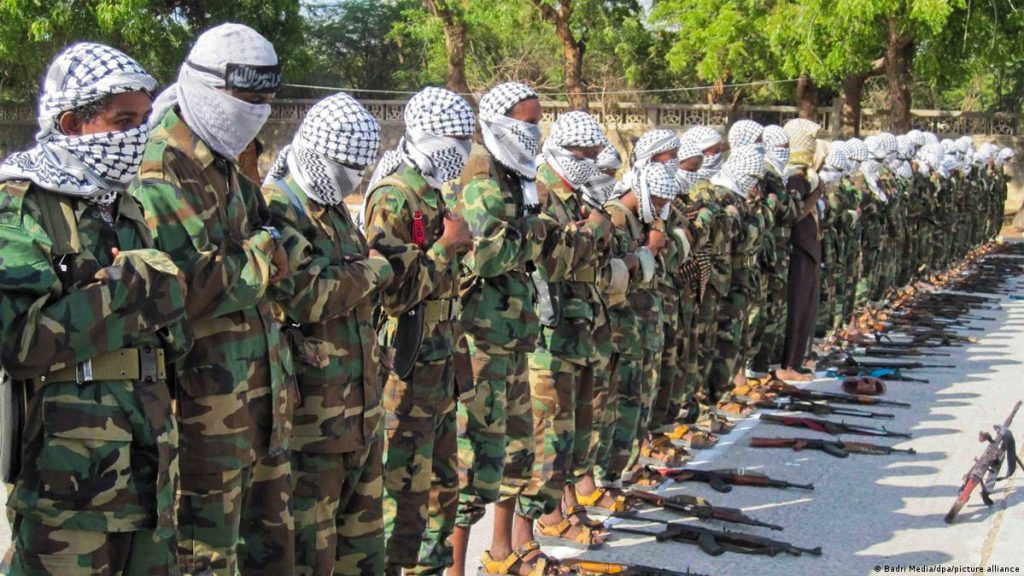
Al-Shabab is an Al-Qaeda-affiliated extremist militant group in Somalia that surfaced as an autonomous organisation in December 2006 after disintegrating from the Islamic Courts Union (ICU) for which it was serving as the military wing.
Its goal is to establish a strict form of Islamic governance in Somalia, based on its interpretation of Sharia law, and has been involved in a series of violent activities, including terrorist attacks, and guerrilla warfare, in an attempt to control Somalia.
Since the fall of the Siad Barre regime, stabilizing Somalia has confounded both national and international actors.
In terms of structure, al-Shabaab is in a state of disarray; many of its key founders have perished, significant sources of funding have dissipated, military pressure continues to mount, and despite recent endeavours by the leadership to implement what they perceive as a people-friendly strategy, public trust and appeal are abysmally low. Consequently, internal dissent has been steadily proliferating and is projected to escalate as the national and regional governments enhance their provision of services
Military campaigns have been the preferred method of engagement, with the Somalia government counterinsurgency efforts backed by ATMIS troops managing to oust al-Shabaab out of key cities. However, ATMIS troops are expected to pull out by December 2024, with the unconvincing expectation that Somali troops will be ready.
The military efforts have, however, had limited achievements, especially on account of political divisions. Relations between the government and federal member states have been less than harmonious, especially under former President Mohamed Farmaajo.
Previous efforts for negotiations have not borne much success. This has been majorly due to al- Shabaab’s leaders turning them down.
One example of this was in January 2018, when the extremists’ spokesperson, Ali Mohamud Rage. openly expressed the group’s distrust in opening dialogue with the government.
Ali, alias Ali Dhere, told Radio Andalus, “Dialogue is more dangerous than the weapons of mass destruction”.
The Somali government has also rejected having peace talks with the militia as recently as January 2023. The denial came after Deputy Defence Minister and MP Kasim Mohamud said the militia requested talks with the government, which National Security Adviser Hussein Sheikh was quick to deny, saying Kasim was being misquoted.
Hussein Sheikh reiterated that the government’s stance on al-Shabaab hadn’t changed. He, however, said individuals who wished to leave the group were eligible for government amnesty after a thorough defection process. In August 2023, another amnesty was offered to militants. The move, coming at a time when ATMIS is drawing back, was seen by some analysts as an attempt to entice al-Shabaab fighters from the battlefield, thereby weakening the insurgent group.
As aforementioned, past attempts have failed, with al-Shabaab also remaining adamant it won’t negotiate with the Somalia government to join its system. The attempts have largely been by the US, and sometimes through Qatar, despite the US State Department designating al-Shabaab as a foreign terrorist organisation in March 2008. The US has a policy of not taking concessions against terrorists.
With the affiliation to Al Qaeda, a sworn enemy of the US, al-Shabaab commanders and members remain committed to anti-America ideology.
The second hurdle is containing the al-Shabaab objective: The group seeks to overthrow the central Somalia government, expel foreign forces, and ultimately establish an Islamic state.
It also has a huge revenue stream from other terror groups and funding from the so-called terror-sponsor states; piracy; kidnapping; and extortion of local businesses, farmers, and aid groups, among others. It is unlikely to give up this, and instead, would want to expand it with Somalia under its control.
Al Shabaab deems the government as illegitimate and shows little readiness to compromise on their vision of Islamist rule. And having sustained the war for at least 15 years, and with Somalia central government differences with federal member states, the group sees itself in a position of relative strength, thus does not get the incentive to negotiate.
But calls for dialogue from civil society, foreign partners, experts, and scholars grow ever louder.
Ahead of the delayed 2022 elections, which initially targeted one-person one-vote, Major Gen (Rtd) Charles Mwanzia, a Kenyan peace and conflict management consultant, proposed dialogue between the national government and federal member states as well as with al-Shabaab, with an invitation of the group to participate in the polls. Mwanzia argued this would not only solve security concerns but also give an opportunity to all Somali citizens to be part of the election.
In an article in 2018, Mary Hope Schwoebel of Nova Southeastern University, Florida, and Mohamed Mukhtar of Savannah State University, Georgia, recommended that former al-Shabab deputy commander Mukhtar Robow (aka Abu Mansur) and now Federal Minister for Endowment, Religious Affairs and Counter-terrorism Ideology ,be allowed to participate in the Southwest State Elections. This idea sought to incentivise al-Shabaab fighters to leave the group and get opportunities in normal life activities.
They argued that if allowed to run for office, Robow would bring his fighters, followers, supporters, and sympathisers into civic life.
“To achieve sustainable peace in this long-suffering region, residents should be granted the right to choose their own leaders – those whom they believe will prioritise the interests and the needs of the people. This is the promise of federalism and how it is supposed to work.’’
“If the international community is genuinely interested in building peace in Somalia, we must acknowledge that history has taught us that the best way to end insurgencies is to bring insurgents into the political process,” they argued.
However, even with the release of Robow and his naming in the Cabinet, the move has not incentivised more militants to defect in what was called the Molly Plan.

Ahlu Sunna Waljama’a paramilitary group
Dialogue and negotiations between the government and some armed groups have been successful to a greater extent in the past, for instance, the Somali Transitional Government and Ahlu Sunna Waljama’a agreement of March 15, 2011.
The 2011 agreement was aimed at pooling together all parties’ resources towards eradicating extremism and terrorism. Part of the agreement was ASWJ’s integration into the Transitional Federal Government in the form of recognizing and supporting administrations established by ASWJ in areas under their control.
The agreement also provided that ASWJ forces would be an integral part of TFG forces and could be deployed by TFG’s central command whenever needed to combat extremist groups. ASWJ were allocated some government positions, ranging from ministers to ministers of state, from Director Generals to Cultural Attaches.
even being internationally viewed as
a legitimate partner of the Somali government
federal administration in October 2021. The group has since been fully integrated into the government, even receiving several international delegates and invitations to UN consultation meetings.
‘Ma’awisley’ Militia
For a time, Somali clans and communities have been grappling with the challenges posed by the al-
Shabaab. These challenges often involve demands such, as taxes referred to as “zakat ” as livestock,
weapons and even recruitment of young boys to join their ranks as fighters.
For years al-Shabaab has successfully suppressed the local uprisings often displaying a brutal efficiency.
The “Ma’awisley,” a reference to the sarong many of them wear, a new militia of farmers become the in 2018 by one local farmer Hibaad Ali Dasar who refused to hand over his 12-year-old son in one of al-Shabaab’s custom raids for money,
rifles, and boys.
The primary objective of the “Ma’awisley” is to safeguard their families and farms. The efforts made by these farmers have been praised by the government, which has even called for an expansion of resistance movements to other regions. The federal government has provided support to the Ma’awisley Militia in terms of ammunition and weaponry. In months government troops have joined forces with militias in an offensive against al-Shabaab.
While it remains uncertain whether or not these local militias, known as “Ma’awisley ” will achieve success there is hope due to the coordination between them and government forces in their fight against al-Shabaab. General Dahir Aden Elmi believes that if sufficient power is granted by the government to support this grassroots mobilization effort it could be instrumental, in defeating al-Shabaab.
The challenges
However, as the Crisis Group argues, al-Shabaab has proven resilient, adjusting to counter-insurgency campaigns and entrenching itself deeper in parts of Somali society.

The AWSJ was allied with government forces against al-Shabaab

but fell out over power-sharing arrangements in the local
first line of defence in the battle for Somalia’s stability. Founded

A huge part of the population is also opposed to the talks given to the atrocities the group has committed and instead prefers its annihilation. Clan politics are also playing a huge factor, blocking attempts at negotiations.
Emboldened by the Taliban’s success in Afghanistan, al-Shabaab could be motivated to pursue its main objective of dislodging the central government, given the federal government’s weakness and external partners’ impatience and the ATMIS force’s withdrawal.
America’s attempts to sustain a formal peace process between the Taliban and the former Afghan government grew defunct when the insurgent movement marched on Kabul, as argued by the United States Institute of Peace, despite the Doha February 2020 agreement. The talks had started as early as 2001 to 2021.
What to do?
It seems calls for dialogue from civil society and foreign actors, while growing louder, are driven by frustration with the status quo more than the existence of an opening.
In Somalia, traditional elders have played a significant role in fostering security and national cohesions, while Somali elders, and business leaders, can be seen as potential facilitators or initiators of a dialogue with al-Shabaab.
Such talks require at least non-opposition from key factions in the FGS and al-Shabaab and more broadly from powerful regional powers who have rejected past agreements. The FGS and international actors need to decide whether they want to maintain their focus on facilitating and promoting defections from al-Shabaab or explore comprehensive talks with the entire armed group.
But as it is, the main players are not keen on negotiating, at least for now. The group, in any case, is recruiting more and graduating more fighters.
What is needed is an intensification of military action against al-Shabaab to weaken it to a point where even if the talks options are on the table, the government is a vantage position. Otherwise, negotiating and allowing al-Shabaab into the government now would be allowing the camel into the tent.
The author is a PhD Candidate, A Senior Consultant at HDC, and works on governance and peacebuilding support in the Horn of Africa.
Email: ali.i.dayow@gmail.com